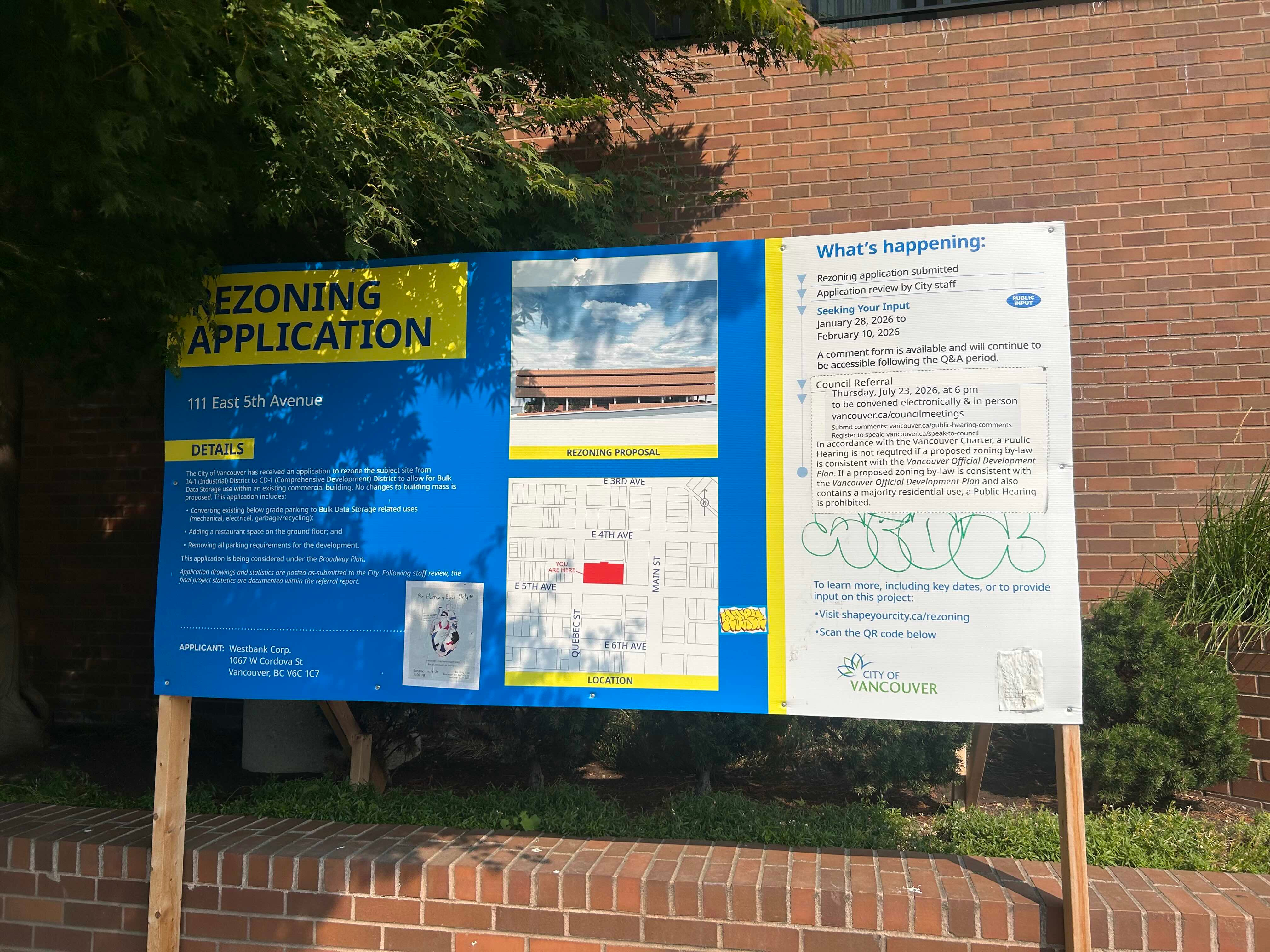
111 East 5th Avenue in Vancouver, B.C., was the proposed site of a GPU-focused data center operated by the Canadian telecom TELUS in partnership with Westbank real estate development company.12 The project, at the edge of Vancouver's Main Street, received the ire of Vancouver residents and AI abolitionists alike as a symbol of AI infrastructure’s potential impact on local communities and prophesied mass displacement of labour.3 Proponents marked it as a step forward for Canadian data sovereignty and a hedge against AI domination from peer and rival nations alike.2 Regardless of your position or whatever future you believe is coming, why an urban office-building conversion was a “reasonable option” for bringing 13,000 GPUs online by 2027 was of interest to me.4 Below I will try and answer that question.
Why Telus and Westbank?
I have no inside look on what motivated either Telus or Westbank internally but to purely speculate, Westbank appears to be re-inventing its core asset class from the depreciating residential condo to the appreciating data center.5 M3’s revitalization appears to be a continuation of this shift. Telus, the originally proposed operator of the data center, appears motivated to continue its expansion into the compute market to chase the predicted insatiable compute demands of 2027. It is building on its existing data centers and GPU cluster in Rimouski opened in 2025.67
Why 111 East 5th Avenue in Vancouver, B.C.?
The proposal would refab M3, Hootsuite’s former headquarters, from an office building and parking garage into a data center. The brick-faced building sits on a 2,767.3 m² site and has three storeys above grade and two below; its sweeping walls extend toward the perimeter, leaving six feet of grass before the sidewalk.1 Assuming the 13,000 GPUs are GB200 Blackwells and allowing 2–3 m of aisle space per rack, we are looking at ~600 m² needed (likely an overestimate) for the compute itself and significant additional space for the cooling, switches and other equipment.8 Based on space alone, the building houses enough square footage to house the desired compute and all the other auxiliary equipment a data center needs. (Liberties are taken in assuming that all square footage is load bearing enough to house the equipment.) The reality is probably that the suitable space for GPUs is much smaller.
However, space alone is insufficient to support a data center, let alone one of this size. Outside of square footage, the three primary physical constraints are power, heat, and fibre (permitting is up there as well).
Carrying on with the assumption that the GPUs are all GB200 Blackwells, the site would produce ~65 exaFLOPS of dense FP8 compute9 and have approximately 26 MW of peak demand.4 Running at that peak for a full year would consume 227.76 GWh.10 Fortunately, M3 sits about 700 metres, as the crow flies, from BC Hydro’s Mount Pleasant Substation.11 The existing station has 150 MVA of capacity at 12 kV.12 BC Hydro is adding a third transformer, converting distribution to 25 kV, and adding 200 MVA of capacity and 20 feeder positions by 2029.1213 BC Hydro had already committed to serving the project’s initial power demand.4 M3’s advantage is that the nearby substation and regional power network already exist. A site requiring a new transmission line and substation has considerably more to build before its first byte. Even a major distribution connection involves roughly 18–42 months of design and construction. That makes proximity to existing power infrastructure a substantial advantage.14
The second problem is heat. M3 was designed to integrate with the City of Vancouver's False Creek Neighbourhood Energy Utility, which serves Olympic Village and is expanding into parts of Mount Pleasant.21516 The utility heats 47 buildings, including homes for more than 10,000 residents.4 Data center projects in Vancouver are required, as a condition of rezoning, to have a heat customer before permitting is given. For other urban build outs, this typically causes significant challenges due to the lack of geographic proximity to potential users of the heat. The City identifies a connection point to the False Creek Neighbourhood Energy Utility at M3’s southwest corner. That gives M3 a nearby destination for its waste heat and helps clear one of the largest blockers to completing a data center in urban Vancouver.16 This arrangement, while likely not totally eliminating the need to disperse heat during summer, further reduces the time to first byte by removing the need for extensive heat transport or towers before the center can come online.
Finally, the business district M3 resides in is already home to extensive fiber and is an area well served by Telus. eStruxture's VAN-1 data center (much, much smaller) sits at 55 East 7th Avenue, 2 blocks away and the operating partner Telus is well versed in laying fiber in Vancouver communities.1718 Compared to other urban locations, this is less of an advantage for M3. However, compared to a true suburban or rural community, the amount of fiber that needs to be laid to connect to the global backbone is significantly less.
All in all, M3’s position next to a substation and a public heat customer largely negates the challenges of building in an urban environment compared to a more rural or suburban center. Given these favorable characteristics and assuming that we do not see a retraction in capital markets for neocloud, I would expect a new partner to be announced in the next year.7
Notes
-
City of Vancouver, CD-1 Rezoning: 111 East 5th Avenue and 2060 Quebec Street, referral report, July 14, 2026. ↩1 ↩2
-
TELUS, “TELUS and Government of Canada advance work to scale Canada’s sovereign AI infrastructure”, May 11, 2026. The announcement described the original TELUS-Westbank partnership, an initial 85 MW secured from BC Hydro, and plans to integrate M3 with the City’s neighbourhood energy utility. ↩1 ↩2 ↩3
-
Isaac Phan Nay, “Vancouver’s Growing Anti-AI Movement”, The Tyee, July 10, 2026. ↩
-
Isaac Phan Nay, “Got Questions About AI Data Centres in Vancouver? Here Are Answers”, The Tyee, May 25, 2026. Reports up to 13,000 GPUs and 26 MW for M3, and BC Hydro’s commitment to serving the data centres’ initial power demand. ↩1 ↩2 ↩3 ↩4
-
City of San José, San José Innovative Project Pathway Program Early Consideration Review Process for a Project Located at 323 Terraine Street, March 21, 2025, p. 2. Identifies Project Terraine LLC (Westbank) as the applicant for a residential tower and an 11-storey data center. ↩
-
TELUS, “TELUS opens Canada’s first fully Sovereign AI Factory”, September 24, 2025. ↩
-
Barney Dixon, “Telus abandons its Vancouver AI data center development plans”, Data Center Dynamics, November 16, 2026. Reports TELUS’s withdrawal and Westbank’s intention to continue with an unnamed partner. ↩1 ↩2
-
Napkin math, assuming GB200 NVL72 systems: 13,000 GPUs ÷ 72 GPUs per rack, rounded up, gives 181 racks. An assumed allowance of 2.3–3.3 m² per rack for cabinets, aisles and service access gives roughly 420–600 m². ↩
-
NVIDIA, “GB200 NVL72”, specifications. NVIDIA lists 720 PFLOPS of sparse FP8 compute across 72 GPUs and states that dense performance is half the sparse figure. Thus 13,000 × (720 ÷ 72 ÷ 2) PFLOPS = 65 exaFLOPS of theoretical dense FP8 performance, assuming that hardware throughout. ↩
-
Calculation at continuous peak demand: 26 MW × 8,760 hours = 227,760 MWh = 227.76 GWh per year. This is a constant-load estimate. ↩
-
The approximately 700-metre straight-line distance is an estimate based on the project location in the City referral report and BC Hydro’s Mount Pleasant Substation at 338 West 6th Avenue, identified on its project page. ↩
-
BC Hydro, Fiscal 2025 Annual Report to the British Columbia Utilities Commission, Attachment 2, section 1, project TX902838, printed pp. 51–52. Describes the existing 150 MVA station at 12 kV, planned conversion to 25 kV, 200 MVA of additional capacity and 20 new feeder positions. It also says that, as of fiscal 2023, all existing feeder positions were used or committed. ↩1 ↩2
-
BC Hydro, “Mount Pleasant Substation upgrade”. The project page schedules completion for 2029. ↩
-
BC Hydro, “Major distribution connections”. Detailed design takes 12–24 months and construction another 6–18 months, totaling 18–42 months for those stages. This excludes the initial request and conceptual review. ↩
-
City of Vancouver, “Neighbourhood energy utility customers”. The City owns and operates the False Creek Neighbourhood Energy Utility, which serves Southeast False Creek and is expanding into parts of Mount Pleasant. ↩
-
City of Vancouver, 111 East 5th Avenue and 2060 Quebec Street referral report, Appendix B, condition 1.11 and the Note to Applicant under condition 1.13. M3 must demonstrate a viable waste-heat recovery and delivery plan before rezoning enactment. The City identifies the NEU connection point along Quebec Street at the site’s southwest corner. ↩1 ↩2
-
eStruxture, “VAN-1 Vancouver Data Center”. Lists the address as 55 East 7th Avenue, electrical capacity as 2.4 MW, and more than 20 carriers on site. ↩
-
TELUS, “TELUS investing $15 billion in British Columbia through 2030 to support Canadian AI leadership, enhance connectivity and drive economic growth”, May 20, 2026. Describes the company’s existing PureFibre network and planned B.C. network expansion. ↩